Launching a business idea feels exciting in the beginning.
You spot a market gap, discuss it with friends, and maybe even picture the brand, product, or customer experience in your head. At that stage, confidence feels high.
But confidence and demand are not the same thing.
Many founders in Dubai invest heavily in businesses based on assumptions. A product “feels” promising. A service “sounds” useful. A market opportunity “looks” profitable.
Then reality arrives.
Customer demand is weaker than expected. Pricing does not work. Competitors already dominate the space. Or worse, the business solves a problem customers never really cared about.
This happens more often than founders expect.
In fact, many startups struggle not because the idea was bad but because it was never properly validated.
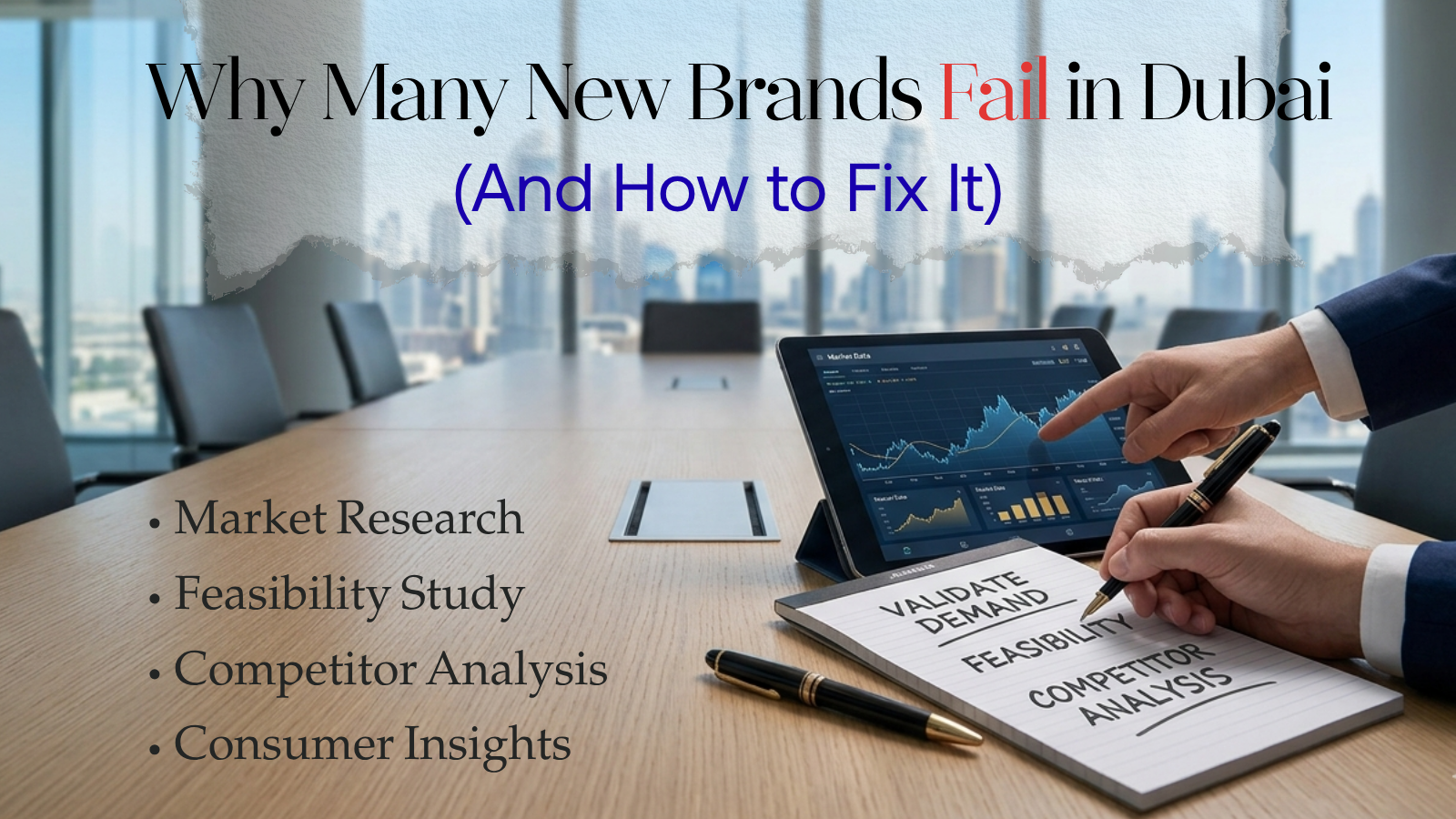
That is why smart founders, investors, and businesses increasingly choose to validate a business idea using market research before making serious investments.
Especially in a fast-moving business environment like Dubai, informed decisions almost always outperform assumptions.
Why Business Ideas Fail Before They Even Begin
A common misconception is that businesses fail after launch.
In reality, many business ideas are already at risk long before they go live.
The biggest reason? Founders mistake personal belief for market demand.
During market research for startups, businesses often discover gaps they never expected:
- Customers are not willing to pay the expected price
- The problem is not urgent enough for consumers
- A competitor already owns the market position
- Consumer behavior is different from what founders assumed
- Demand exists, but for a different audience segment
Many businesses entering Dubai underestimate how quickly customer preferences shift across industries. Consumer expectations in sectors like food, retail, healthcare, fintech, real estate, and digital services evolve rapidly.
This is where business idea validation becomes essential.
The goal is not to prove your idea right.
The goal is to understand whether the market agrees with your idea.
How Market Research Reduces Business Risk
Starting a business without research is often expensive.
Launching without understanding the customer, pricing, competition, or demand creates avoidable risks.
Professional startup market research reduces uncertainty by answering practical business questions:
Is there real demand?
A product may sound attractive internally, but do people actually want it?
This is where market demand analysis matters. Businesses assess search demand, buying behavior, customer pain points, and purchasing intent before launch.
Who exactly is the customer?
Many founders initially describe their audience as “everyone.”
That rarely works.
Strong target audience research helps identify:
- Demographics
- Lifestyle and purchasing behavior
- Pain points
- Spending capacity
- Expectations and motivations
In UAE consumer research projects, businesses often discover their ideal customers are different from their original assumptions.
Sometimes the opportunity exists, just for a different audience.
Is the business commercially viable?
This is where a feasibility study becomes valuable.
A startup feasibility analysis looks beyond demand and evaluates business viability, operational practicality, competition, market conditions, and financial sustainability.
This step becomes particularly important when the investment size is large.
How to Validate a Business Idea Step by Step
Validating a business idea is not about collecting random opinions.
It requires structured research.
1. Understand the Problem You Are Solving
Before validating demand, define the actual customer problem.
Ask yourself:
- What pain point does this solve?
- Is the problem important enough for people to pay for a solution?
- How are customers solving this today?
If the problem is weak, the business opportunity often is too.
2. Conduct Competitor Analysis
A strong competitor analysis does not focus on copying competitors.
It focuses on understanding market gaps.
Professional research teams usually assess:
- Competitor pricing
- Service models
- Customer reviews
- Brand positioning
- Market weaknesses
Customer reviews are especially useful.
Repeated complaints often reveal opportunities.
For example, businesses entering Dubai frequently discover competitors offer strong products but inconsistent service. That insight alone can shape a stronger go-to-market strategy.
3. Conduct Consumer Research
Assumptions should always be tested against real customer feedback.
This is where consumer research becomes valuable.
Some of the most effective validation methods include:
Surveys
Useful for measuring preferences, demand, price sensitivity, and customer expectations.
Customer Interviews
Direct conversations reveal deeper emotional triggers and buying motivations.
Focus Groups
Useful for testing concepts, branding, packaging, or customer reactions.
Concept Testing
Businesses present an idea before launch to understand market reaction.
Primary & Secondary Research
Professional business research services often combine primary research (customer feedback) with secondary research (industry reports and competitor data).
This creates a clearer picture of the market opportunity.
How to Validate Pricing Before Launch
Pricing mistakes quietly kill good ideas.
Founders often price products emotionally rather than strategically.
Too expensive? Customers leave.
Too cheap? Profitability suffers.
In Dubai’s competitive market, pricing also affects perceived trust and positioning.
Research can help businesses understand:
- What customers are willing to pay
- Preferred pricing models
- Competitor benchmarks
- Price sensitivity
Many startups discover during feasibility studies that customers value convenience, trust, or service speed more than low prices.
That insight can completely shift a launch strategy.
Signs Your Business Has Product-Market Fit
One of the strongest indicators of success is product-market fit.
This happens when demand naturally aligns with your offering.
Some positive signals include:
- Strong customer interest before launch
- Positive feedback during concept testing
- High engagement or waiting lists
- Repeat inquiries
- Clear willingness to pay
Without product-market fit, growth becomes harder, and marketing costs usually increase.
A Quick Real-World Example
Imagine a founder planning to launch a premium healthy meal subscription service in Dubai.
Initially, the assumption is simple: healthier meals equal higher demand.
But after conducting market demand analysis, competitor research, and customer interviews, the findings reveal something different.
Customers care less about premium ingredients and more about speed, affordability, and flexible subscription plans.
Instead of overspending on branding and premium packaging, the founder adjusts the business model around convenience.
The result?
A stronger launch backed by actual consumer insight, not assumptions.
When Should You Hire a Professional Market Research Company?
Basic research can be done independently.
But when larger investments, new markets, or strategic decisions are involved, professional research becomes valuable.
Businesses often seek support when:
- Launching a startup in Dubai or the UAE
- Entering a new market
- Testing a new concept or product
- Conducting a feasibility study
- Understanding consumer behavior
- Evaluating business expansion opportunities
Professional researchers bring structured methodologies, customer segmentation, concept testing, market intelligence, and unbiased insights.
That reduces risk before serious investment begins.
Final Thoughts
The strongest businesses rarely launch based on assumptions alone.
They launch with clarity.
Before investing in branding, hiring, inventory, technology, or expansion, understanding customer demand can save both time and capital.
If you are planning to launch, expand, or test a business idea in Dubai or the UAE, market research can help you evaluate demand, understand customer behavior, and reduce uncertainty before making critical business decisions.
Frequently Asked Questions
-
Do I need market research before starting a business in Dubai?
Yes. Market research helps businesses understand customer demand, competitors, pricing expectations, and market opportunities before investing.
-
Can market research tell if my startup idea will work?
Market research cannot guarantee success, but it can significantly reduce uncertainty by validating demand, customer interest, and product-market fit.
-
How do startups validate a business idea?
Startups typically validate ideas through customer interviews, surveys, competitor analysis, concept testing, and feasibility studies.
-
What is the difference between market research and a feasibility study?
Market research focuses on customer demand and competition, while a feasibility study evaluates overall business viability, financial practicality, and operational feasibility.